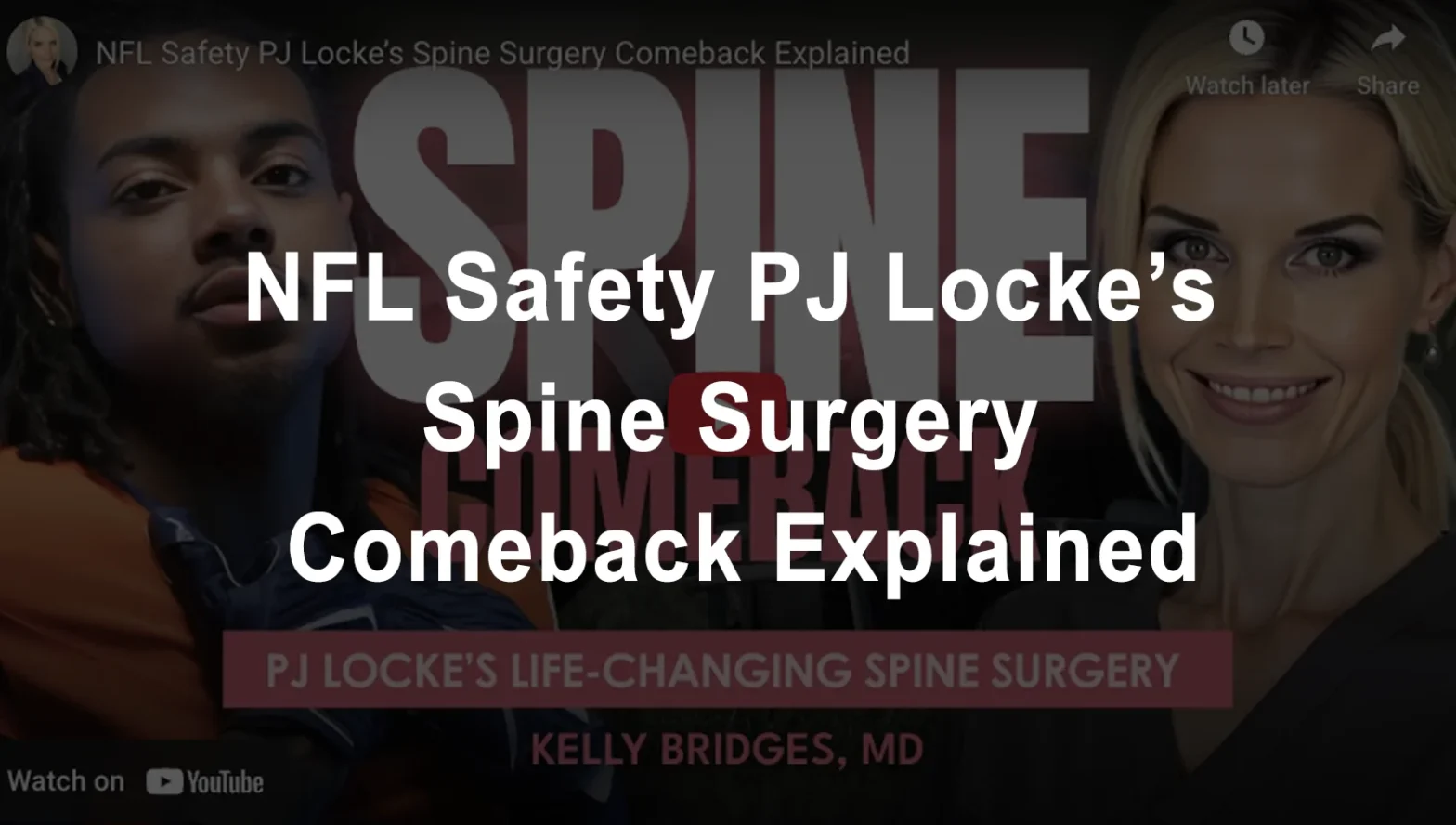
NFL Safety PJ Locke’s Spine Surgery Comeback Explained
Football, Spine Surgery, and a Remarkable Recovery
It’s football season and today we’re talking about something that hits close to home, spine surgery. Denver Broncos safety PJ Lockach recently shared his journey through a posterior lumbar fusion in a powerful YouTube video. His words, “It ain’t nothing compared to what I was experiencing. It’s been a miracle.” I’m Dr. Kelly Bridges, board certified neurosurgeon and a huge football fan. Let’s break down what happened, what it means, and why this surgery, often misunderstood, can be positively life-changing.
Understanding the Anatomy Behind the Injury
Your spine is made up of stacked rings of bones called vertebrae separated by discs that act like shock absorbers. Between each pair of vertebrae is a small tunnel called a fammen where nerves exit and travel to places like your legs, feet, and hips.
In PJ’s case, the problem was at the L45 level low in the lumbar spine. His disc had degenerated, losing height and cushioning. In addition, the L4 vertebrae had slipped forward over L5, a condition called spondyololisthesis. This slip narrowed the fammen, compressing the L4 nerve root, the one responsible for things like thigh sensation, movement of certain leg muscles, and the patellar reflex, that classic knee-jerk response.
When nerves get pinched like that, it can cause pain, numbness, tingling, or weakness.
Playing Through Pain and the MRI Findings
PJ was playing through it. Over a thousand defensive snaps last season, but the pain was relentless. From what I can tell in his video, PJ’s MRI seemingly revealed severe right L45 parameinal stenosis. That tunnel was nearly closed off.
He experienced pain and his reflex was diminished because his right L4 nerve wasn’t firing properly.
What a Posterior Lumbar Fusion Involves
PJ underwent a posterior lumbar fusion, a procedure designed to stabilize the spine and relieve pressure on the nerves. Here’s what that surgery involves.
The surgeon accesses the spine from the back. A portion of the bone is removed to decompress the nerves. This part of the surgery is called a laminctomy. Screws are placed into the vertebrae and connected with rods to hold everything in alignment. Often times, a cage filled with bone graft is inserted into the disc space to promote fusion. This is where the bone grows between the vertebrae over time, permanently stabilizing that level.
The surgeon accesses the disc space through a small opening between the nerves that live at this level of the spine.
An Unexpected Surgical Challenge
During PJ Lock surgery, his neurosurgeon encountered something rare, a conjoined nerve root. That means two spine nerves were connected together in the same space, like two lanes of traffic merging into one.
In PJ’s case, this anatomical variation was sitting right where the surgeon had planned to insert the fusion cage on the right side of the disc space. Trying to pass a cage there would have risked injury to those nerves.
So, the surgical plan had to change. The surgeon widened the opening on the left side of the spine where the nerves were more safely spaced and successfully place the cage from the direction instead.
Adjusting the Game Plan
It’s a perfect parallel to football. You might walk onto the field with a play in mind, but when the defense shifts, you’ve got to pivot. That kind of quick thinking and adaptability, whether in the O or on the grid iron, is what leads to a win.
The Moment That Changed Everything: Reflex Recovery
In PJ Lock’s YouTube video, there’s a moment that speaks volumes. His surgeon checks PJ’s patella reflex, and you can see it. The leg kicks out. That reflex recovered.
And for anyone who understands spine surgery, that’s caused for celebration.
Here’s what’s happening behind the scenes. The L4 nerve root controls the patella reflex. When the doctor taps the tendon just below the kneecap, it sends a signal up the nerve to the spinal cord, which immediately fires a signal back down to the quadriceps muscle, telling it to contract. That kick is the body’s way of saying message received.
Before surgery, PJ’s L4 nerve was compressed, likely silencing that reflex. But after decompression and stabilization, that nerve could finally do its job again.
Why That Small Movement Matters
That simple leg movement isn’t just a clinical detail. It’s a sign of recovery, of restored function, of a nerve back in the game.
In football terms, it’s like a safety making a clean read and reacting instantly. No hesitation, no delay, just precision. PJ’s reflex returning, that’s not just a win, it’s a neurosurgical touchdown.
Rethinking Spine Fusion Surgery
Spine fusions get a bad rap. You hear horror stories, but PJ Lock’s journey shows what’s possible when the diagnosis is clear, the surgical technique is precise, the patient is motivated and compliant, and the care team is committed to a good outcome.
His surgeon, Dr. Chad Presmac, took the time to adapt the plan, protect the nerves, and ensure a safe fusion. And PJ, he’s back on the field calling the experience a miracle.
What We Can Learn From PJ Lock’s Spine Story
So, what can we learn from PJ Lock’s spine story? that spine surgery isn’t about hardware. It’s about hope. That nerves can recover, that pain can be relieved, and that with the right care, even elite athletes can return to the game.
If this helped you understand spine surgery or gave you hope for your own journey, give it a like, share it with someone who needs it, and subscribe for more clear, compassionate breakdowns of the brain, spine, and everything in between.